
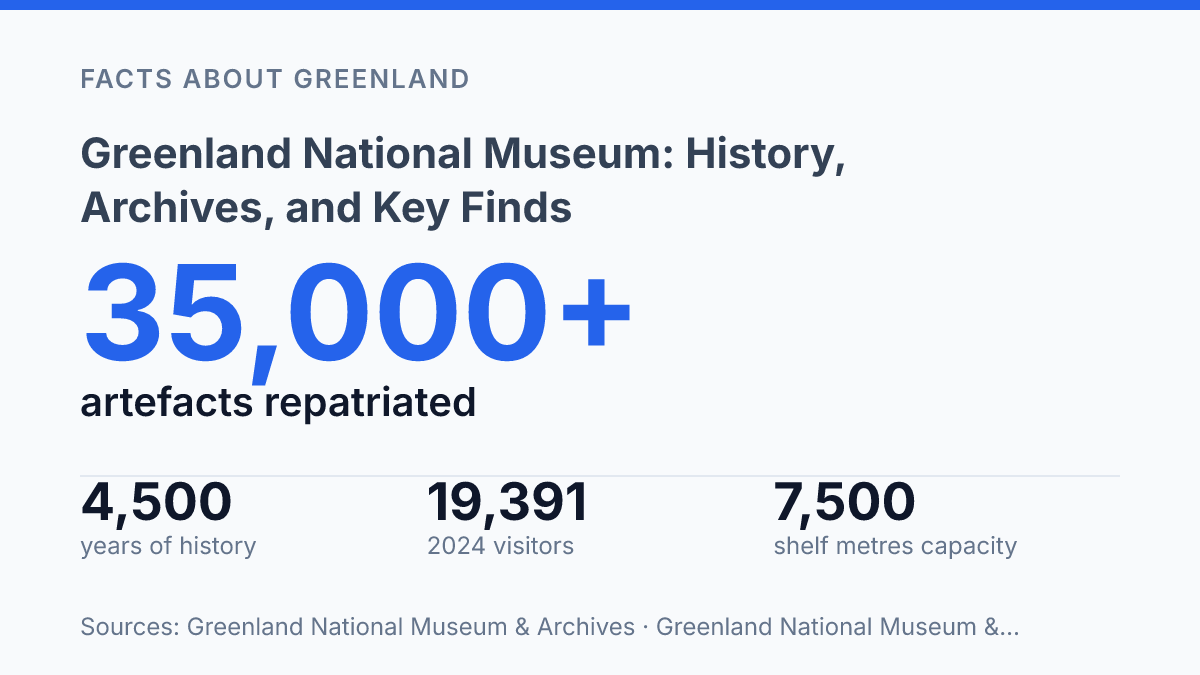
The Greenland National Museum & Archives compresses 4,500 years of Greenlandic history into seven permanent exhibitions, but its public role extends well beyond display cases. In Nuuk, the institution connects archaeology, ethnography, repatriated cultural material, and state records in one place, making it both a museum and a memory system for Greenland. Its collections include the 15th-century Qilakitsoq mummies, ethnographic material from Ammassalik and Avanersuaq dating to 1880–1920, and the Pearyland Umiaq, described by the museum as the world’s oldest virtually intact skin boat.
The scale is also institutional: more than 35,000 artefacts have been returned to Greenland since the repatriation process began in 1982. This article explains how the museum’s exhibitions, collections, archives, research function, and visitor information fit together as parts of a national cultural institution.
What the museum covers
Greenland’s past is presented at the Nuuk institution as a long material timeline, with official exhibitions tracing 4,500 years of history across seven permanent displays arranged chronologically, according to the Greenland National Museum & Archives. That structure gives the museum a broad remit: it is not limited to a single period, community, or colonial-era narrative, but connects early settlement evidence, later cultural change, and modern historical memory through objects that can be examined, conserved, and compared.
Based in Nuuk, the museum functions as a national preservation institution for archaeological and cultural heritage. Its core work centres on excavated tools, crafted objects, domestic items, hunting equipment, clothing, and other artifacts that document how people lived, travelled, worked, and adapted in Greenland over time. Such material evidence is especially significant in a country where climate, distance, and dispersed settlement patterns have shaped both what survives and what can be recovered.
The museum’s collections are closely linked to the national archives because objects and records answer different parts of the same historical questions. Artifacts can show technique, material use, exchange, and daily practice; archival records can identify people, institutions, decisions, and later interpretations. Kept within the same national framework, these sources support preservation, research, repatriation work, and public access to Greenland’s historical record.
This combined role also has limits. A museum built around excavated and collected material can preserve evidence from periods far earlier than written documentation, but archival coverage is not necessarily even across older eras or remote regions. The institution therefore represents Greenland’s history through both presence and absence: preserved tools and crafts can make deep history visible, while gaps in records help define where archaeological evidence, oral knowledge, and later documentation must be read together.
Key collections and what they show
A skin boat known as the Pearyland Umiaq is described by the museum as the world’s oldest virtually intact skin boat, a rare survival because Greenlandic watercraft were usually made from perishable hide and wood. Its value is not only age or preservation; it shows the technical knowledge required to travel, hunt, and transport people in Arctic conditions where boat design could shape the limits of settlement and seasonal movement.
Excavated tools and craft materials give a more detailed view of earlier communities than monuments alone can provide. Stone blades, scrapers, harpoon components, needles, and worked bone or antler objects point to repeated tasks: preparing skins, repairing clothing, processing food, making equipment, and adapting hunting gear to local animals and climate. These objects are small, but their wear marks, raw materials, and find locations can show whether a site was used for dwelling, workshop activity, travel, or seasonal hunting.
Collections linked to hunting, trade, and domestic life also help trace contact and change over time. Hunting equipment records the importance of seal, whale, bird, and land-animal resources, while household items such as lamps, vessels, sewing tools, and clothing fragments reveal how warmth, food storage, and repair work were managed inside homes. Ethnographic holdings from Ammassalik and Avanersuaq dated to 1880–1920, according to Greenland National Museum & Archives, preserve later regional material culture and make it possible to compare recorded practices with older archaeological evidence.
The best-known human remains from Qilakitsoq, dated to the 15th century, show how organic materials can transform historical interpretation when preservation conditions are exceptional. Clothing, hair, skin, and grave context provide evidence for health, dress, burial practice, and family or community life that ordinary stone and bone finds cannot supply on their own.
These holdings also connect precolonial, Norse, and later Inuit histories without treating them as a single uninterrupted story. Norse farm remains, Inuit hunting technologies, imported trade goods, and locally made tools all show that Greenland’s past involved both continuity and replacement, adaptation and contact. After the 1983 Denmark–Greenland repatriation agreement, more than 35,000 artefacts have been returned to Greenland, according to the museum, strengthening the ability to interpret objects within their archaeological and cultural setting rather than as isolated museum pieces.
Archives, research, and public record
At the start of 2025, about 6,167 shelf metres of archival material were already in use out of roughly 7,500 shelf metres of storage capacity, according to the Greenland National Museum & Archives Annual Report 2024. That scale makes the archive function more than an administrative attachment to the museum; it is a national record-keeping system that preserves documentary evidence alongside the material culture held by the same institution.
The relationship between museum and archive is especially significant for research because objects rarely explain themselves without records. Archival holdings can help establish when an item was collected, where it came from, who handled it, and how earlier researchers or authorities described it. This evidence supports provenance checks, clarifies uncertain identifications, and gives curators a firmer basis for interpretation when written documentation, oral history, and material analysis need to be compared.
Researchers working on Greenlandic history, archaeology, language, family history, governance, and heritage protection depend on the National Archives as a source of primary documentation. In 2024, the institution registered 50 archival collections, according to the same annual report, showing that the public record is not static. New accessions and cataloguing work can alter what is searchable, strengthen older research, or open questions that were previously difficult to document.
Archival access also carries practical limits that shape scholarship. Fragile records may require preservation controls before consultation, and cataloguing depth can determine whether a researcher finds a relevant file quickly or only after broader investigation. Language is another factor, since records relating to Greenland may appear in Greenlandic, Danish, or other research languages depending on period and origin.
These constraints do not reduce the archive’s value; they explain why archival interpretation is a specialist process as well as a public service. When records are preserved, described, and connected to collections, they improve historical accountability by making claims about origin, ownership, use, and meaning easier to test against documentary evidence.
Visit details in Nuuk
A single central address carries most of the practical information needed for an in-person visit: Hans Egedesvej 8, Nuuk 3900, Greenland. The museum is located in Greenland’s national capital, which also functions as the main access point for many visitors to the country. That position makes the institution comparatively straightforward to identify within the city, even though broader travel to Greenland remains shaped by distance, weather, and limited transport options.
For direct contact, the museum’s listed telephone number is +299 32 26 11. The address and phone details are the most reliable practical references to use when confirming location-specific information, since public access details can change and should be checked through the institution’s own channels before a visit.
Why the museum’s public role keeps expanding
A museum of this kind is not only measured by rare objects or visitor totals. Its longer significance lies in how material culture, public records, repatriation, and access are managed as living infrastructure. The 2024 figures show that the institution is balancing several demands at once: nearly full archival storage, seasonal tourism peaks, rising digital attention, and the ongoing costs of heritage protection.
Those pressures are likely to grow as more records are preserved, more collections are interpreted, and more visitors look for context before arriving in Nuuk. The practical consequence is clear: each exhibition label, archive metre, and returned object carries administrative weight as well as cultural meaning.
Frequently Asked Questions
Q: What can visitors see at the Greenland National Museum?
A: The museum presents Greenland’s history through excavated tools, crafts, and artifacts, with collections that help explain daily life, trade, and cultural change over time. It also includes national archives, which broadens its role beyond exhibition space.
Q: Where is the Greenland National Museum located?
A: The museum is at Hans Egedesvej 8, Nuuk 3900, Greenland. Its location in the capital makes it a central stop for visitors interested in the country’s historical collections and archival material.
Q: Does the museum include historical archives?
A: Yes. Alongside museum displays, it holds national archives, which makes it a reference point for historical research as well as public education. That combination gives the institution a broader documentary role than a standard local museum.
Q: What kind of artifacts are part of the collection?
A: The collection includes excavated tools, crafts, and other artifacts tied to Greenland’s past. These objects provide material evidence of how people lived, worked, and adapted to local conditions across different periods.
Q: How can someone contact the museum?
A: The museum can be reached by phone at +299 32 26 11. Contact details like this are useful for confirming opening arrangements, archive access, or practical visit information before traveling.