
Nuuk now holds 35.8% of Greenland’s population. It still sits beside a fjord system so large that the city can feel like a small interruption in the rock and water.
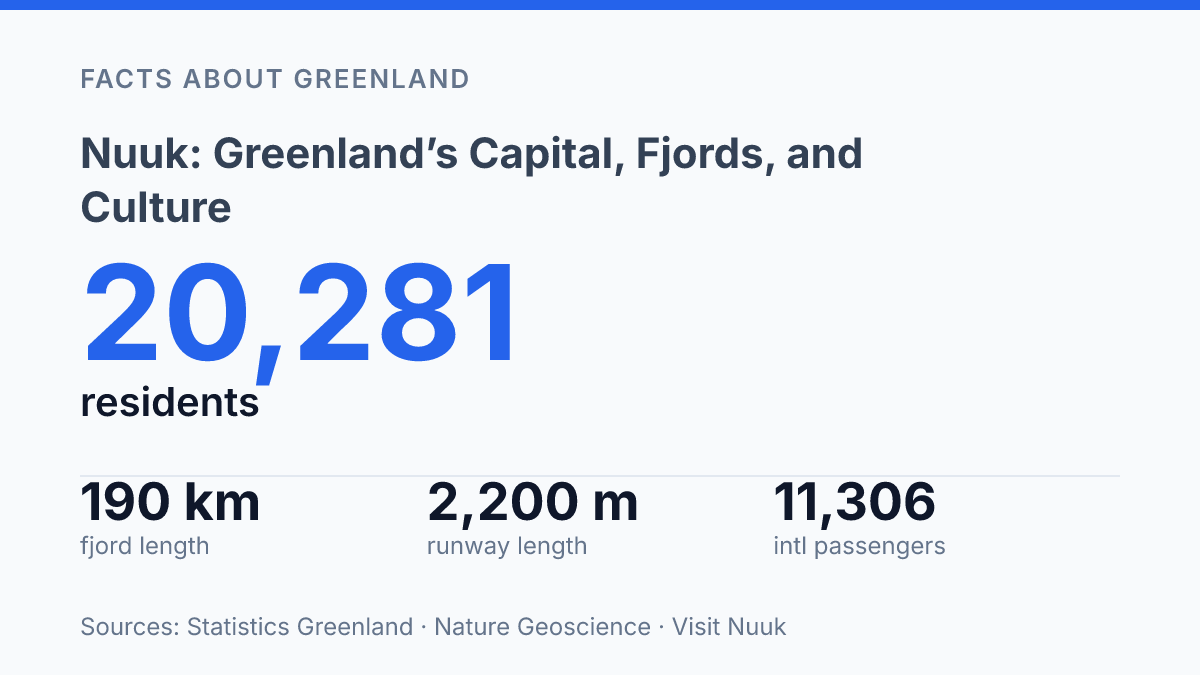
That contrast is the point. Greenland’s capital is growing fast, with 20,281 residents recorded in October 2025, but its strongest impression still comes from scale: steep streets, cold light, and Sermitsiaq rising 1,210 metres about 15 km away.
Access changed on November 28, 2024, when the new international airport opened with a 2,200-metre runway. Passenger numbers had already jumped from 5,263 in 2022 to 11,306 in 2024. In my honest opinion, the mistake is treating the city as a stopover.
Stay long enough and the waterfront, Nuup Kangerlua, the National Museum, Katuaq. The art museum start to show a capital under pressure from growth, weather, memory, and beauty.
Why Nuuk stands out on Greenland’s southwest coast
Greenland’s capital has fewer people than a mid-sized university campus, yet more than a third of the country lives there.
Nuuk is Greenland’s capital city, set on the southwest coast where Greenland faces Davis Strait. That position gives it national weight without metropolitan scale. Government offices, apartment blocks, shops, and harbor activity sit close enough together that the city still reads as compact rather than grand.
As of October 1, 2025, the city had 20,281 residents, up 397 from the same date in 2024, and 35.8% of Greenland’s population lived in the capital, according to Statistics Greenland’s 2025 quarterly population figures. That concentration would be ordinary in a large country, but in Greenland it changes the mental map. The capital is small on paper and dominant in practice.
Compared with better-known Arctic capitals such as Reykjavík, it feels far less like a full urban spread and much more like a national center pressed into a coastal pocket. You don’t get the anonymity of a big city here. You get the odd mix of parliament-level importance and end-of-the-road remoteness.
That contrast is the point. In my view, the city’s power lies in that mismatch: it carries the administrative weight of a capital. It never lets you forget how far it is from the usual capital-city script.
The fjord system that shapes the city
The fjord beside the capital runs farther inland than many visitors expect: Nuup Kangerlua stretches about 190 km, according to Nature Geoscience in 2023. That scale changes how the city feels.
You’re not just looking at a pretty harbor. You’re looking into a deep marine system with arms, islands, cliffs, and glacial valleys pulling the eye away from town.
From a distance, the water can look almost still. But that calm is deceptive. Seasonal meltwater, tides, wind, and drifting ice keep the fjord in motion, even when the surface looks smooth from shore.
Nature Geoscience measured the wider fjord area at 2,013 square kilometers and linked its catchment to three marine-terminating glaciers. That’s why icebergs can appear in the area like slow-moving weather.
Waterfalls add another layer to the route through the fjords. They don’t feel decorative here. They mark where high rock, snowmelt, and gravity meet the sea.
In summer, the flow can turn thin white lines into louder streams that drop straight from dark slopes. It gives boat trips a sense of scale that photos rarely catch.
Wildlife follows the same rhythm. Humpback whales feed in these waters during the warmer months, and their presence feels tied to the fjord rather than separate from it. You might scan for a tail or a blow.
The better lesson is patience. The place doesn’t perform on demand.
That’s the tradeoff for visitors. The fjord system around Nuuk rewards time. It doesn’t always offer clean guarantees.
Fog can hide cliffs. Wind can shift plans. Ice can make the route feel wilder than expected. In my honest opinion, that unpredictability is exactly what makes the scenery feel alive, not staged.
Colorful waterfront views and Sermitsiaq mountain
The most recognizable view is a study in opposition: toy-bright houses at the water’s edge, then a hard wall of rock rising behind them. Red, blue, yellow, and green facades give the harbor a clean rhythm. They help the city read clearly from the water before you understand its streets.
That color isn’t just pretty. It gives scale to a place where the natural forms can overpower everything built by hand.
The houses look cheerful and orderly. The mountain behind them makes the setting feel stark and severe.
Sermersoq is the visual anchor most visitors remember, even when they don’t know its name at first. According to Lex.dk’s April 16, 2025 update, the mountain sits about 15 km northeast of the city and rises to 1,210 metres above sea level.
That height matters in photos. It turns a harbor scene into something unmistakably Greenlandic.
For orientation, the mountain works like a compass point. If you lose your sense of direction near the waterfront, look up.
The slope gives you a fixed reference. The harbor buildings pull your eye back down to the human scale.
This is why the waterfront view carries so much weight in first impressions. It compresses the city’s identity into one frame: painted houses, working harbor edges, cold light. A mountain that refuses to become decorative. In my humble opinion, that contrast is the real signature, not the color alone.
Photographers get the best results when they treat the scene as layered, not flat. The houses provide the foreground.
The harbor adds reflection and distance. Sermitsiaq supplies the pressure in the background… and that pressure is what keeps the image from turning into a postcard cliché.
Museums and cultural stops worth time
Four mummies from Qilakitsoq pull the city’s history out of the abstract and make it uncomfortably human. At the Greenland National Museum, the separate exhibition room for those remains gives visitors one of the strongest cultural encounters in the country.
Greenland National Museum & Archives dates the burials to around 1475. The museum displays four of the eight mummies found in two graves.
The same institution also carries a much longer story. Visit Greenland says its exhibitions cover 4,500 years of Greenlandic history, from early Arctic cultures to later colonial contact.
The Inuit skin boats are the part you shouldn’t rush. The Pearyland Umiaq, described by Visit Greenland as the world’s oldest almost-complete intact skin boat, shows how survival here depended on design as much as endurance.
A short cultural walk can shift from ancient materials to local visual art faster than you’d expect. The Nuuk Art Museum opened in 2005 and occupies about 600 square metres, according to the museum’s listed 2025/2026 visitor information. That compact scale works in its favour.
You’re not moving through a giant collection built to impress donors. You’re reading a city through paintings, drawings, and Greenlandic viewpoints.
Katuaq gives the capital its public cultural pulse. Opened on February 15, 1997, the centre hosts films, concerts, exhibitions, talks, and community events rather than acting like a polished showpiece for tourists alone. Visit Nuuk lists Hans Lynge Hall with seating for up to 508 people, and about 70% of Katuaq’s events are free.
That matters. Culture here isn’t locked behind a velvet rope.
The biggest surprise is how much deep history and contemporary art sit inside such a small capital… and that mix gives the city real weight. But the contrast is sharp.
One hour can put you in front of centuries-old burial clothing. The next can place you inside a modern concert hall. In my view, that tension is exactly what makes these stops feel necessary, not optional.
What easier access doesn’t change
Plan one flexible day, not one perfect route. The new terminal can handle 800 passengers per hour, but fog, wind, and boat schedules still decide what the day becomes.
Use that uncertainty well. If the fjord is calm, go out toward the water.
If the weather closes in, give the museums real time. The Qilakitsoq burials from 1475 and the stage at Katuaq belong in the same trip, not as backup plans but as evidence of a capital with depth.
In my humble opinion, the best visit here doesn’t chase every viewpoint. It leaves room for the place to push back. Greenland’s capital rewards travelers who treat distance, silence, and delay as part of the experience, not flaws in the plan.
Frequently Asked Questions
Q: What is Nuuk best known for?
A: Nuuk is known for its fjord system, colorful waterfront, and strong cultural life. The fjords bring waterfalls, humpback whales, and icebergs close to the city. The appeal isn’t just scenic. In my view, the mix of nature and everyday life is what makes it stand out.
Q: Is Nuuk worth visiting for first-time travelers to Greenland?
A: Yes, because it gives you a clear look at both Greenlandic city life and the surrounding wild coast. You can see Sermitsiaq mountain from the waterfront, then step into museums and cultural spaces without leaving town. That contrast makes the visit feel focused, not rushed.
Q: What can you do in Nuuk besides sightseeing?
A: You can visit the Greenland National Museum, the Nuuk Art Museum. The Katuaq cultural center. The museum collection includes mummies and Inuit skin boats, while Katuaq hosts films, concerts, and art. That’s a strong indoor option when the weather turns.
Q: Can you see whales or icebergs near Nuuk?
A: Yes, both are part of the fjord experience around Nuuk. Humpback whales and icebergs are seen in the large fjord system. That makes boat trips especially popular. The surprise is how close this feels to the city itself.
Q: What is Nuuk like as a city?
A: Nuuk is a small capital on Greenland’s southwest coast. It doesn’t feel plain. The waterfront is lined with brightly colored houses. The mountain backdrop gives it a sharp visual edge. In my honest opinion, that mix feels more personal than a bigger capital does.